

Hong Kong CIES: Structuring HK$30M Investments for HNWIs' Residency and Wealth Planning

Hong Kong is a premier international financial center.
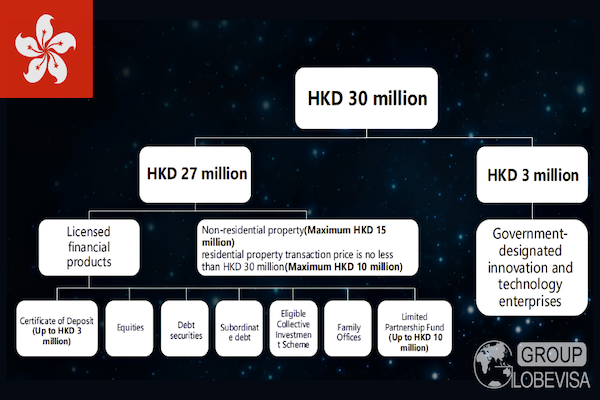
Structure of the HK$30 Million Investment Threshold and Permissible Asset Allocation under the Hong Kong New CIES.
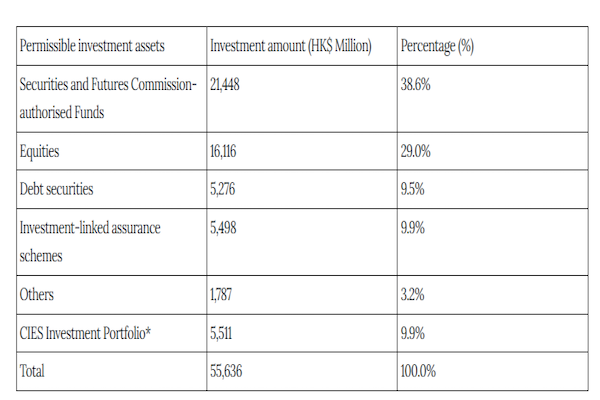
Distribution of Actual Investment Asset Classes by New CIES Applicants (Source: InvestHK, as of March 2026).
SG, SINGAPORE, July 15, 2026 /EINPresswire.com/ -- Globevisa Group has released a comprehensive industry analysis detailing the structural asset allocation strategies for the reactivated Hong Kong CIES (Capital Investment Entrant Scheme). For global high-net-worth individuals (HNWIs) and family wealth managers, selecting a specific jurisdiction for cross-border residency planning is no longer merely about acquiring a single identity document; it is a critical strategic decision intricately tied to global asset allocation. Amid a complex global macroeconomic environment, the scheme is increasingly emerging as a pivotal destination for international wealth management. This trend is driven by Hong Kong's safe-haven attributes as a global financial center, a transparent low-tax regime, mature international educational resources, and a unique geographical advantage for overseeing Asian regional operations.
However, allocating HK$30 million (approximately US$3.8 million) into a single market with a mandated seven-year lock-up period introduces a classic wealth management challenge: How can investors strictly adhere to the Hong Kong Immigration Department’s compliance requirements while maximizing portfolio liquidity and mitigating global asset risk exposure in volatile markets?
As an international HNWI wealth management and cross-border identity consultancy headquartered in Singapore, Globevisa Group has operated within the global compliance and residency planning sector for over two decades. Following the initial launch of the Hong Kong Capital Investment Entrant Scheme in 2003, Globevisa Group tracked the policy’s evolution and facilitated residency for its first cohort of investors in 2004. With the recent reactivation of the HK$30 million New CIES, the firm's localized project team at Harbour City in Tsim Sha Tsui, Hong Kong, has assisted applicants in securing approvals for the initial wave of New CIES applications, applying structured legal compliance and institutional risk control protocols.
Drawing upon analytical insights derived from a historical database of over 120,000 global cases and comprehensive lifecycle management experience—from initial asset auditing to the final transition to permanent residency at the seven-year mark—this newly published analysis examines the policy's structural foundations. By systematically deconstructing the HK$30 million capital structure, the report aims to inform investors on structuring a balance among risk control, capital preservation, and cash flow generation.
The HK$30 Million Capital Structure: The Underlying Logic of Bifurcated Management
The regulatory framework of the New CIES explicitly divides the total investment threshold into two distinct, non-interchangeable components. Understanding this architecture is the prerequisite for building an effective risk control model:
●HK$3 million (Strategic Support Portfolio): This capital tranche is strictly directed toward innovation, technology, and other strategic industries, officially managed by the Hong Kong Investment Corporation (HKIC). From an asset perspective, investors must treat this as an illiquid, closed-end, long-term allocation without the authority to rebalance or adjust holdings independently.
●HK$27 million (Permissible Investment Assets): This tranche can be deployed into officially designated "Permissible Financial Assets" and "Real Estate." This segment represents the core arena for investors to exercise institutional risk control and macroeconomic asset allocation, allowing for autonomous selection and dynamic adjustments tailored to individual risk appetites and liquidity needs.
Comparative Analysis of Four Permissible Asset Classes: Balancing Volatility and Liquidity
Within the HK$27 million discretionary quota, different asset classes exhibit distinct financial characteristics throughout the seven-year compliance cycle required to maintain residency status.
1.Listed Equities
●Compliance Requirements: Must be shares listed on the Hong Kong Stock Exchange (HKEX) and traded in either HKD or RMB.
●Liquidity Profile: High. Positions can be liquidated or adjusted on any standard trading day.
●Risk Characteristics: High market volatility. While the policy stipulates that investors are not required to top up their accounts if the market value of their assets falls below the initial threshold, frequent portfolio rebalancing in a highly volatile market can easily crystallize paper or floating losses into realized capital deficits.
●Allocation Strategy: In sophisticated family wealth management models, equities are rarely positioned as heavily weighted, defensive underlying assets. Managers typically cap their allocation percentages, prioritizing blue-chip stocks with robust fundamentals and steady dividend yields to secure predictable income streams.
2.Public Funds & Eligible Collective Investment Schemes
●Compliance Requirements: Must be authorized public funds managed by asset management companies licensed by the Hong Kong Securities and Futures Commission (SFC).
●Liquidity Profile: Moderately High. Most open-ended funds facilitate daily or weekly subscription and redemption.
●Risk Characteristics: Low to Medium (highly dependent on the underlying asset). The primary advantage of funds lies in risk diversification; institutionalized operations spread capital across a broad spectrum of targets, effectively hedging against severe fluctuations in any single asset.
●Allocation Strategy: For investors prioritizing capital preservation, institutional-grade fixed-income funds (e.g., investment-grade bond funds) function as defensive assets. They offer steady yields while maintaining manageable price volatility.
3.Real Estate (Residential & Non-Residential)
●Compliance Requirements: The investment cap for non-residential properties (retail shops, office spaces, etc.) is HK$15 million; for residential properties, the single transaction value must be HK$30 million or above, of which a maximum of HK$10 million can be counted toward the minimum investment threshold.
●Liquidity Profile: Low. Real estate transactions entail protracted lifecycles and involve substantial upfront sunk costs, including stamp duties, legal fees, and brokerage commissions.
●Risk Characteristics: Exhibits a significant capital lock-up effect and exposes investors to market pricing cycles and holding costs (such as maintenance and vacancy costs).
●Allocation Strategy: Given that residential property is capped at a HK$10 million compliance contribution, acquiring an eligible residential asset means the investor must deploy an additional HK$20 million in personal capital outside the CIES framework. From an international liquidity management perspective, unless a family has a definitive need for local habitation or commercial operations, real estate may be a less efficient compliance vehicle.
4.Investment-Linked Assurance Schemes (ILAS)
●Compliance Requirements: Must be an SFC-authorized investment-linked assurance scheme issued by an authorized insurer in Hong Kong.
●Liquidity Profile: Medium to Low. Such products commonly impose early lock-up periods, and premature surrender may incur penalty fees.
●Risk Characteristics: Market risk is predominantly tied to the underlying fund products linked within the policy.
●Allocation Strategy: The core value of ILAS lies in its administrative wrapper functionality and wealth succession attributes. During the seven-year compliance period, investors shifting underlying funds within the policy structure are generally exempt from cumbersome external audit confirmations by regulatory bodies. Furthermore, its trust-like legal structure integrates seamlessly with cross-generational wealth transfer planning.
The Dynamic Rebalancing Mechanism Within the Compliance Framework
The scheme permits investors to switch investments across "Permissible Assets," but this flexibility must be executed strictly within regulatory boundaries:
●Dedicated NCIES Account: All financial transactions must be conducted within a dedicated account opened at an eligible financial institution. During rebalancing, the principal must strictly remain within the regulatory ecosystem and cannot flow into personal, day-to-day consumption accounts.
●Transaction Time Windows: Upon selling an asset, the liquidated funds must be fully reinvested into new compliant assets within an officially mandated timeframe. Exceeding this idle cash window will result in a direct interruption of residency compliance.
●Asymmetry in Yield Extraction: Capital gains (the appreciated portion of the principal) must remain locked within the portfolio. However, cash dividends, bond coupons, and net rental income generated by the assets can be freely extracted to support the investor’s global operations and living expenses.
Market Trends and Structural Compliance Insights from Globevisa
According to preliminary data released by InvestHK in March 2026, approximately 38.6% of deployed capital in approved portfolios was allocated to the fund market, and 29% to the equity market. Real estate allocations were practically zero, with the remainder distributed across other financial products.
Synthesizing these macroeconomic figures with the operational realities of the seven-year transition to permanent residency, the analysis highlights four structural frameworks for international investors, outlining an alignment between capital efficiency and strict compliance mandates:
1.Structuring a "Barbell Portfolio" to Mitigate Compliance Risks
Although the policy states that investors do not need to top up their accounts if market values fall, a deep drawdown of the HK$30 million principal after seven years still represents a friction point in overarching wealth preservation. From a structural standpoint, successful applicants often utilize a Barbell Strategy: allocating the vast majority of the discretionary tranche (e.g., 60%–70%) into SFC-authorized institutional-grade funds or fixed-income bonds to lock in downside protection, while assigning a minority fraction (under 30%) to blue-chip equities to offset long-term inflationary pressures.
2.Assessing the "Hidden Costs" of Real Estate for Residency Purposes
Official data indicates that real estate accounts for a negligible share of actual allocations. From a pure liquidity and compliance standpoint, Hong Kong property transactions carry substantial sunk costs, primarily via stamp duties. Moreover, the lengthy liquidation cycle poses a risk during the seven-year compliance window; urgent portfolio rebalancing could easily breach the strict "time window" limits for reinvestment, jeopardizing residency status. The analysis notes that real estate is typically utilized as a pure compliance tool only if a family has a genuine need for local habitation or commercial expansion.
3.Leveraging Distribution Mechanisms to Establish Transnational Cash Flow
A central structural benefit of the CIES policy is the permission to freely extract dividends, interest, and rental yields generated by the investments. When screening eligible assets, optimizing the portfolio to include products with built-in periodic distribution mechanisms is a widely utilized structural approach. For instance, holding bond funds with stable annualized yields allows the investor to legitimately withdraw a predictable cash sum periodically. This can be deployed for regional living expenses or to operationalize other ventures, thereby enhancing overall capital utility without breaking the immigration lock-up rules.
4.Utilizing ILAS to Optimize Family Succession and Administrative Management
Financial markets will inevitably cycle through macroeconomic shifts over a seven-year horizon. Directly holding individual stocks or bonds and executing manual portfolio rebalancing exposes the investor to rigorous accounting declarations and strict time-window constraints imposed by the Immigration Department. Globevisa’s structural planning experts observe that for family offices prioritizing efficiency or HNWIs with definitive succession objectives, structuring assets via an Investment-Linked Assurance Scheme (ILAS) functions as a structured framework. Rebalancing within the policy wrapper bypasses frequent external compliance audits, and the legal architecture of the insurance contract seamlessly folds into the family’s wealth succession matrix upon maturity.
About Globevisa Group
Established in 2002, Globevisa Group (the organiser of GGCC) is an international consultancy specialising in cross-border asset allocation, residency, and citizenship planning, operating over 50 direct branches worldwide. Globevisa is committed to providing global high-net-worth clients with one-stop identity and asset structuring solutions that meet the highest international regulatory standards, working alongside global partners to shape the future of international mobility. For more information, visit https://www.globevisa.com/.
Disclaimer: This material is intended for informational and strategic planning purposes only and does not constitute financial, investment, or legal advice. Any reference to "Hong Kong" herein strictly denotes the Hong Kong Special Administrative Region of the People's Republic of China (HKSAR). Readers are strongly advised to consult certified financial planners, licensed asset managers, and legal professionals prior to executing any investment or immigration decisions.
Globevisa Group Team
Globevisa Group
email us here
Visit us on social media:
LinkedIn
Instagram
Facebook
YouTube
TikTok
X
Legal Disclaimer:
EIN Presswire provides this news content "as is" without warranty of any kind. We do not accept any responsibility or liability for the accuracy, content, images, videos, licenses, completeness, legality, or reliability of the information contained in this article. If you have any complaints or copyright issues related to this article, kindly contact the author above.
