

AI Maps Sleep-Promoting Effects of Nearly 1,000 Aromatic Plants
AI Maps Sleep-Promoting Effects of Nearly 1,000 Aromatic Plants
Study uses artificial intelligence to analyze sleep-promoting effects of nearly 1,000 aromatic plants and recognize the top candidates
Only a few aromatic plants, like lavender, are widely used for sleep. We used AI to systematically explore nearly 1000 aromatic plants and identify their scent molecules linked to sleep effects.”
SINGAPORE, SINGAPORE, February 11, 2026 /EINPresswire.com/ -- Sleep problems affect millions of people worldwide and are linked to a wide range of health issues, from poor concentration and mood disorders to long-term risks such as cardiovascular disease. While sleeping pills are commonly prescribed, concerns about side effects, dependency, and long-term use have led many people to look for gentler, more natural ways to improve sleep.— Dr. Dachuan Zhang, National University of Singapore
Aromatic plants and essential oils are among the most popular natural approaches. For centuries, they have been used in traditional practices and, more recently, in wellness products such as aromatherapy and sleep aids. However, despite the enormous diversity of aromatic plants in nature, only a handful—most notably lavender—are widely used today. For the vast majority of aromatic plants and the scent molecules they release, their potential effects on sleep remain largely unknown.
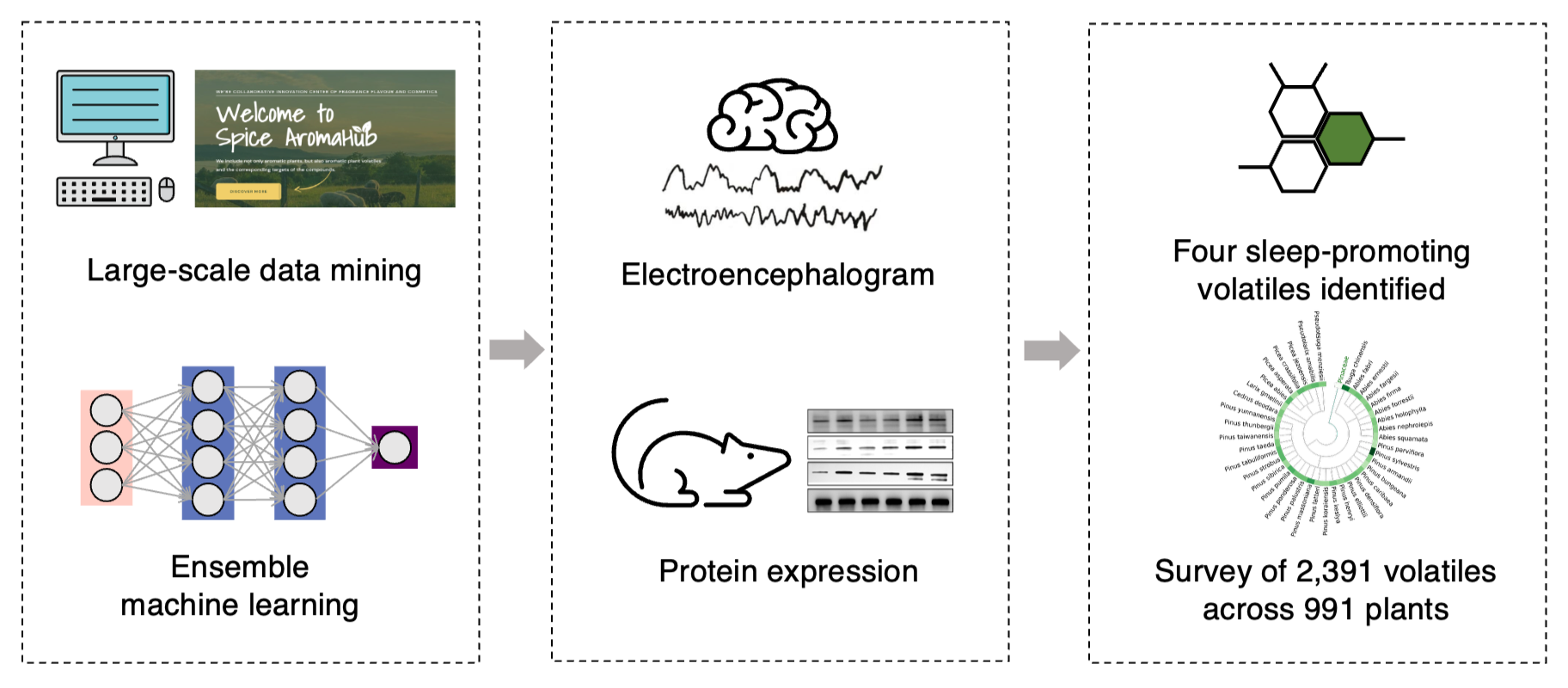
A new study published in Digital Discovery set out to address this knowledge gap using artificial intelligence (AI). The research team systematically collected data from more than 970 scientific publications, building a large dataset of 2,391 volatile organic compounds (VOCs) derived from 991 different aromatic plant species. These VOCs are the small, easily evaporated molecules responsible for plant aromas and are thought to influence the brain through the sense of smell.
Using this dataset, the researchers trained and compared multiple AI models to predict whether individual scent molecules might have sleep-promoting effects. Rather than relying on a single complex model, the team found that combining several well-established machine learning methods produced more stable and reliable predictions. This ensemble AI model was then used to screen all collected plant-derived VOCs.
To test whether the AI predictions reflected real biological effects, the researchers selected five candidate molecules for laboratory experiments. Brain activity recordings (EEG) in mice showed that four of these compounds—carvacrol, safranal, vanillin, and methyl eugenol—helped reduce time spent awake and increased total sleep duration. These effects were mainly due to longer periods of non-rapid eye movement (NREM) sleep, a stage of sleep considered important for physical recovery. Further analyses suggested that these effects were linked to changes in GABA-related signaling in the brain, a well-known pathway involved in sleep regulation.
Beyond individual molecules, the study also looked at aromatic plants as complete biological sources. By combining AI predictions with information on which VOCs occur in which plants, the researchers assessed the overall sleep-promoting potential of different plant groups. Several plant families traditionally associated with calming effects, including the mint family (Lamiaceae), the daisy family (Asteraceae), and the laurel family (Lauraceae), were found to contain multiple VOCs with high predicted sleep-related activity. At the species level, plants such as lavender (Lavandula angustifolia), perilla (Perilla frutescens), basil (Ocimum basilicum), and Vitex (Vitex negundo) stood out as examples rich in potentially sleep-promoting aroma compounds.
“At the moment, only a very small number of aromatic plants, such as lavender, are widely used for sleep-related applications,” said Dr. Dachuan Zhang, Assistant Professor at the National University of Singapore and the lead corresponding author of the study. “Yet nature offers thousands of aromatic plant species, and for most of them we still do not know which scent molecules may influence sleep. Our goal was to use AI to systematically explore this largely uncharted space and provide a data-driven starting point for future research.”
All data and AI models used in the study have been made freely available through the Zenodo platform, allowing readers to examine the aromatic plants of interest to them and other researchers to reuse the approach or apply it to different questions involving natural products and health effects.
Overall, the study shows how AI can be used to explore the hidden health potential of natural scents. By moving beyond a few well-known plants and systematically examining hundreds of species, the work opens new possibilities for understanding how aromas influence sleep and for guiding future research into natural-based health solutions.
Future studies will also investigate how multiple aroma compounds may work together through synergistic or interactive effects, as discussed in the new npj Science of Food review, since natural plant extracts typically contain complex mixtures rather than single molecules.
Publication details:
Peiqin Shi, Xing Huang, Qinfei Ke, Xingran Kou, and Dachuan Zhang. Mapping sleep-promoting volatiles in aromatic plants with machine learning: A comprehensive survey of 2300 molecules. Digital Discovery, 2026. https://www.doi.org/10.1039/d5dd00173k (open-access)
Qinfei Ke, Jingzhi Zhang, Xin Huang, Xingran Kou, and Dachuan Zhang. Machine learning unveils three layers of food complexity. npj Science of Food, 2026.
https://doi.org/10.1038/s41538-026-00730-w (open-access)
Dachuan Zhang
FoodAI Research Group at NUS
dachuan.zhang@nus.edu.sg
Legal Disclaimer:
EIN Presswire provides this news content "as is" without warranty of any kind. We do not accept any responsibility or liability for the accuracy, content, images, videos, licenses, completeness, legality, or reliability of the information contained in this article. If you have any complaints or copyright issues related to this article, kindly contact the author above.
